Why a Concert Set Gains Momentum Through Contrast
Concert set momentum comes from contrasts in pace, texture and intensity; learn how to hear the shifts and choose what to follow as a listener.
Why does one concert set gather force while another feels like a string of separate pieces? Concert set momentum often comes from contrast: a shift in pace, texture or intensity changes how the next passage lands. Listening for those turns can make a performance feel shaped without requiring you to know the music in advance.
Momentum does not simply mean playing faster or louder. A quiet passage can sharpen attention before a full ensemble enters; a busy section can make a spare ending feel newly exposed. Performers shape these relationships through what they play and how they connect one selection to the next.
Three kinds of contrast
Pace is the most immediately recognisable change. A brisk passage followed by a measured one can make the slower music seem spacious, while a sudden quickening may bring a sense of release. Listen for the character of the pulse, not just the speed: a steady beat, a loping rhythm and a restless pattern can feel distinct even at a similar tempo.
Texture describes how musical parts are arranged. A solo voice or instrument against silence has a different feel from several lines moving together. You might hear a melody pass from one player to another, a repeated figure grow denser, or an accompaniment drop away. Those changes alter what holds your attention.
Intensity concerns the energy of a passage, which is not identical to volume. A restrained section can feel tense if its notes are closely packed or its rhythm unsettled; a loud passage may feel open and celebratory. Notice how articulation, register, rhythm and ensemble weight contribute, rather than treating loudness as the only signal.
Three listening approaches
Follow the pulse
Choose this approach if changes of pace help you stay oriented. Notice when the beat seems to settle, loosen or press forward, and ask how that affects the next section. It is especially useful in music with repeated rhythms, dance-like patterns or clear changes between quick and slow passages.
Track the texture
Choose this approach if you enjoy hearing how parts fit together. Follow one strand, such as the bass line, a vocal melody or a recurring instrumental figure, and notice when it is joined, answered or left alone. This suits ensemble music in which the hand-offs between players are prominent.
Sense the intensity
Choose this approach if you respond strongly to shifts in energy. Listen for changes in attack, density and register as well as volume. It can be rewarding in music that builds gradually or moves between contained and expansive passages, even when its tempo stays steady.
You need not commit to one approach for the whole concert. Start with whichever feature is easiest to hear, then switch when the music draws your attention elsewhere. If the beat is hard to follow, the changing number of active parts may be clearer; if the texture remains stable, notice how the performers shape intensity.
How should you listen?
Does a louder passage always build momentum?
No. A rise in volume can increase intensity, but momentum may also come from a quicker pulse, a new rhythmic pattern or a change in who carries the melody. A quiet passage can move a performance forward by creating expectation.
What if the pace stays steady?
Listen for texture and phrasing instead. New layers can enter, a repeated line can shift between performers, or the music can become more or less accented while keeping its underlying pulse.
Can a pause change the shape?
Yes. A pause can separate musical ideas or make the return of a sound feel more pointed. Notice whether the silence seems to close a thought, hold it open or prepare a new one.
How can you choose one thing to follow?
Pick the feature that is easiest to recognise in the moment: beat, musical layer or energy. Stay with it for a passage, then change focus when a clear shift catches your ear.
Choosing a focus
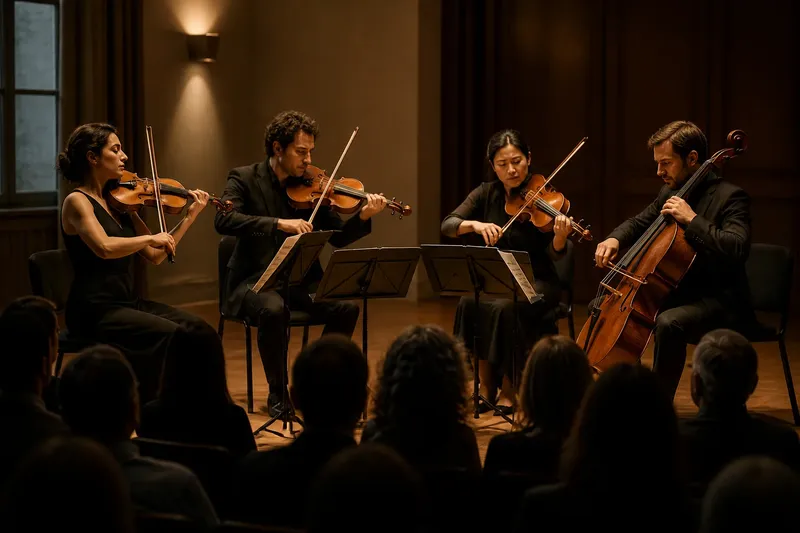
Imagine you are at a small ensemble concert. A nimble opening gives way to a slower passage in which one instrument carries the tune while the others fall back. You could follow the pulse as it relaxes, track the melody’s newly exposed line, or notice the change from busy energy to restraint. Each route reveals the same transition from a different angle; choose the one that helps you hear what changed.
For a set with sharply different pieces, following pace may make the sequence easy to grasp. In music built around interweaving lines, tracking texture may reveal connections that a tempo-focused listen misses. When the performance moves through gradual crescendos or sudden releases, intensity may be the clearest thread. These are useful starting points, not rules about what a set ought to do.
Hear the handover
Transitions can create momentum between pieces as well as within them. A performer may let the final sound fade before beginning something new, or carry a rhythm straight into the next passage. Notice whether the incoming music answers, interrupts or contrasts with what came before; that relationship can make the sequence feel connected without making every piece sound alike.
Next time you listen, choose one contrast to notice and give it your attention for a while. Then ask what the change made newly audible: a pulse, a musical line, a silence or a fresh surge of energy. That small question is enough to make concert set momentum easier to hear, and to let each shift contribute to the shape of the performance.